
Appearance
Creating a Google Slides template
A Google Slides template is a deck in Google Drive that your project starts each new edition from, such as the weekly sales update or the monthly board deck. Its guide tells the assistant how an edition is made, so "make this week's update" gives you a deck that looks like the last one without you explaining it again.
Only the project owner and administrators can add templates and change guides. Other members can read a guide.
1. Prepare the deck in Google Slides
Start from a finished edition, or a deck in your house style.
- Replace the text that changes each edition with a placeholder: a name in double braces, in lower-case words joined by
_. For exampleWeek {{week}},{{top_region}} grew mostorRevenue {{revenue_total}}. - Every number in the text changes each edition, so it gets a placeholder too.
- Keep headings, labels and fixed wording as they are.
- Put instruction or example slides in if they help, and give them the role Delete in the copy later.
You don't have to do this by hand: Refine template with AI does it for you (see Let the assistant do the work).
2. Add it to the project
- Click Templates in the project's icon strip
- Click Add template and choose Google Slides link
- Type a Name, paste the deck's Google link and click Add
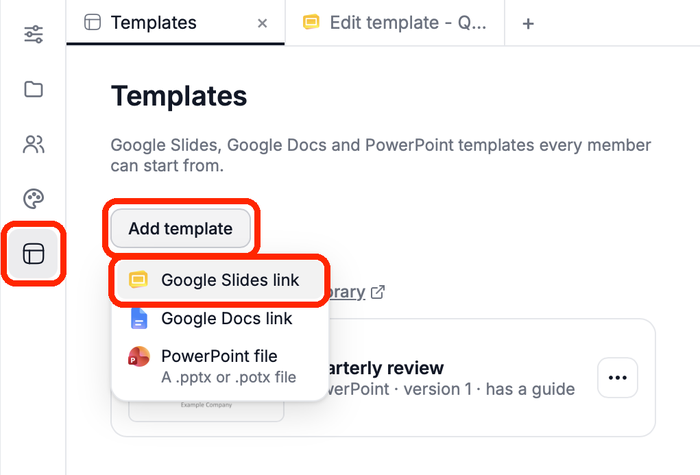
Hub checks that it can open the deck, then opens the template's guide.
3. Write the guide
The guide opens in an Edit template tab, on the Template & context tab. Later, open it again by clicking the template under Templates in the project's icon strip. Changes save as you type; the top of the guide shows when it was last saved.
Write it the way you would brief a new colleague. The assistant reads it every time it makes a presentation from this template.
The presentation
The top of the guide describes the deck as a whole.
| Field | What to write | Example |
|---|---|---|
| Purpose | Who it is for and what it answers | "Monthly update for the board: revenue, churn and the three biggest wins." |
| How it is made | The steps, and where the numbers come from | "Revenue from the finance export in the Finance folder; churn from the CRM report." |
| Brand rules | One rule per line, up to 20 | "Body text never below 14 pt" |
| Cadence | How often a new one is made | Weekly, Every two weeks, Monthly, Quarterly or When needed |
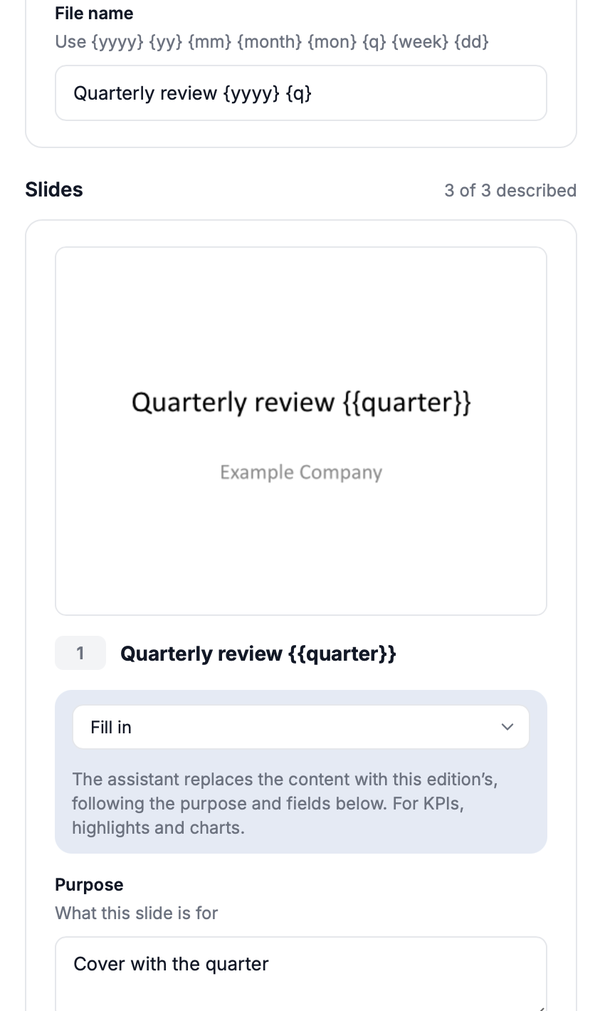
| File name | How each edition is named, with date tokens | Acme MBR {yyyy}-{mm} gives "Acme MBR 2026-11" |
How it is made matters most: name the actual sources (a folder, an export, a report), in the words your team uses. The assistant asks for anything it cannot find there, and never makes numbers up.
The File name tokens are filled in with the date of the new edition:
| Token | Becomes |
|---|---|
{yyyy} / {yy} | Year: 2026 / 26 |
{mm} / {dd} | Month / day as two digits: 11 / 20 |
{month} / {mon} | Month name: November / Nov |
{q} | Quarter: Q4 |
{week} | Week number (ISO) |
The slides
Below the presentation, the guide lists every slide of the template with its thumbnail (click it to enlarge), and counts how many are described. For each slide, set a role, a purpose and its fields.
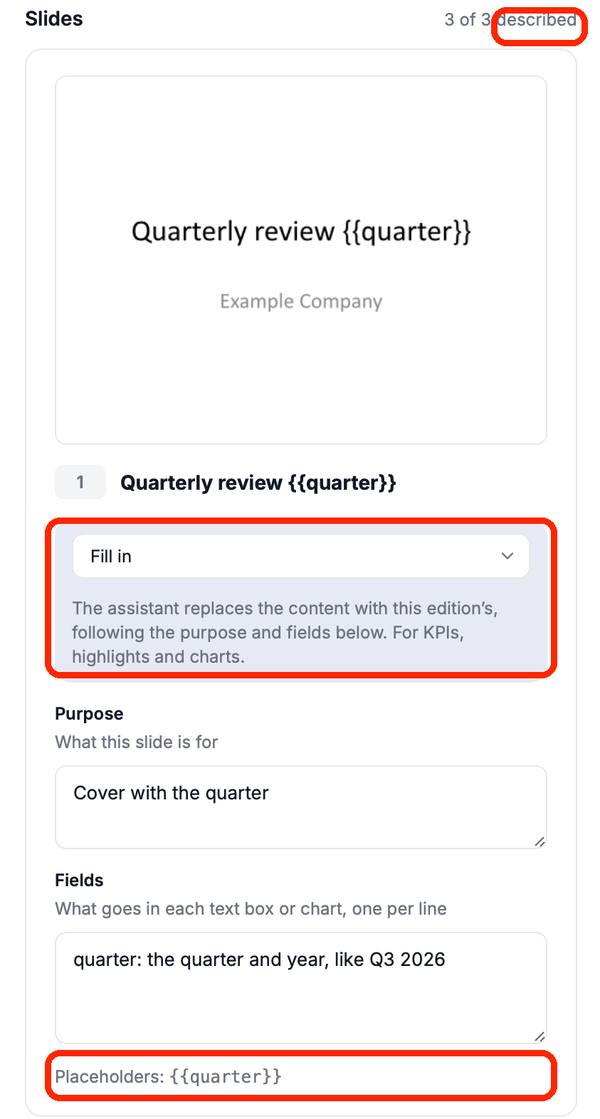
Role says what the assistant does with the slide:
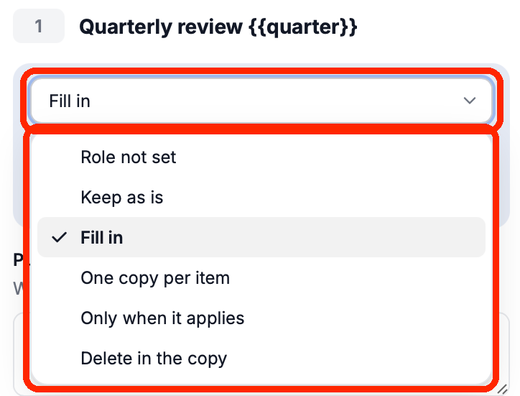
| Role | What the assistant does | Use it for |
|---|---|---|
| Keep as is | Leaves the slide exactly as it is | The cover, agenda, method or contact slides |
| Fill in | Replaces the content with this edition's, following the purpose and fields | KPIs, highlights and charts |
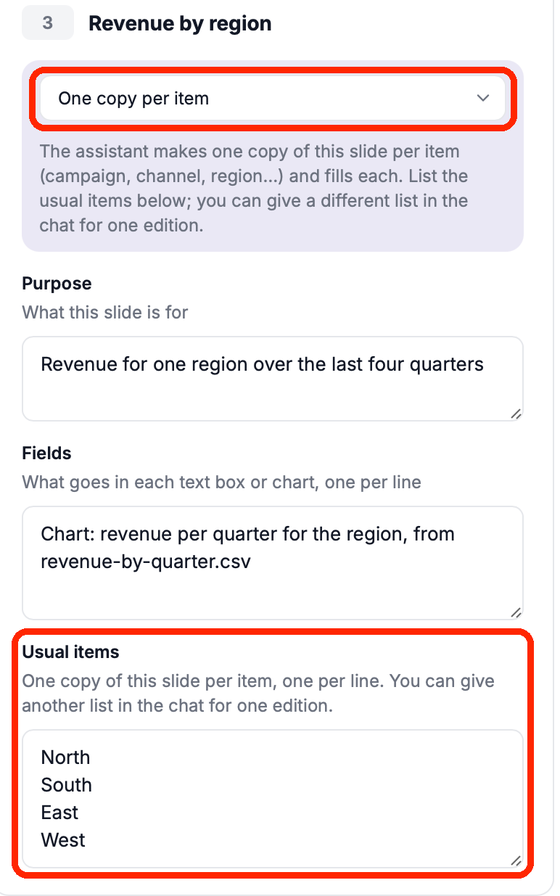
| One copy per item | Makes one copy of the slide per item and fills each | One slide per region, campaign or channel |
| Only when it applies | Keeps and fills the slide only when its purpose applies this time, otherwise deletes it | Incidents, promotions, seasonal slides |
| Delete in the copy | Always deletes the slide from the new deck | Instruction or example slides in the template |
A slide without a role is kept as it is, unless you ask otherwise.
Purpose says what the slide is for, such as "The three biggest wins of the quarter, each with a number". The assistant uses it to decide what belongs on the slide, and for Only when it applies, whether the slide is needed this time.
Fields say what goes in each text box or chart, one per line, as name: instruction:
quarter: the quarter and year, like Q3 2026
highlights: three bullets from notes.md, each with one number
Chart: revenue per quarter for the region, from revenue-by-quarter.csv
Give every placeholder on the slide a field with the same name. Under the fields, the guide lists the slide's placeholders and warns you about one with No field yet, and about a field whose placeholder is Not in the slide any more.
Usual items appear only for One copy per item: the items to make a copy for, one per line, up to 30. The assistant uses this list unless you give another one in the chat for one edition.
Tips for a good guide
- Write instructions a colleague could follow without asking you: where the number comes from, how many bullets, what to compare with.
- Describe every slide, even the ones you keep. "3 of 3 described" at the top of the slides means nothing is left to guesswork.
- Put house rules that apply to every slide in Brand rules, not in each slide's fields.
- Keep placeholder names stable between versions of the template. Editions and guides refer to them by name.
Let the assistant do the work
On a Google Slides template, Refine template with AI prepares the deck and writes the guide in one go. While there is no guide yet, you can paste Links to finished presentations (optional) first, so it can learn from earlier editions.
The assistant then:
- Asks you what the deck is for, how often it is made and where its numbers come from, unless the guide already says
- Turns the text that changes each edition into
{{placeholders}}, including every number, and keeps headings and fixed wording - Sets every chart to example values, with a placeholder in its title
- Writes the guide to match: purpose, cadence, how it is made, file name, and a role and fields for every slide
It never adds, deletes or reorders slides; it asks you about that instead. It edits the template deck itself, so undo anything you don't want with Google's version history. Check the guide afterwards and adjust what it could not know.
When the template changes
Edit the deck in Google Slides as usual. When you delete a slide, its guidance is kept under Guidance for slides no longer in the template. Use Move to slide… to attach it to another slide, or Remove it.
The other tabs
- Chart defaults: the chart style for charts in decks made from this template. See Chart defaults.
- Presentation theme: the theme colors of the template. Fonts and layouts are changed in Google Slides under Slide › Edit theme; Edit theme in Google opens it.